 Moss
Game servers that keep growing, quietly.
A fast, local-first controller. One small binary, a polished web panel, and servers that survive everything except you pulling the plug.
MOSS_AUTH=dev ./moss serve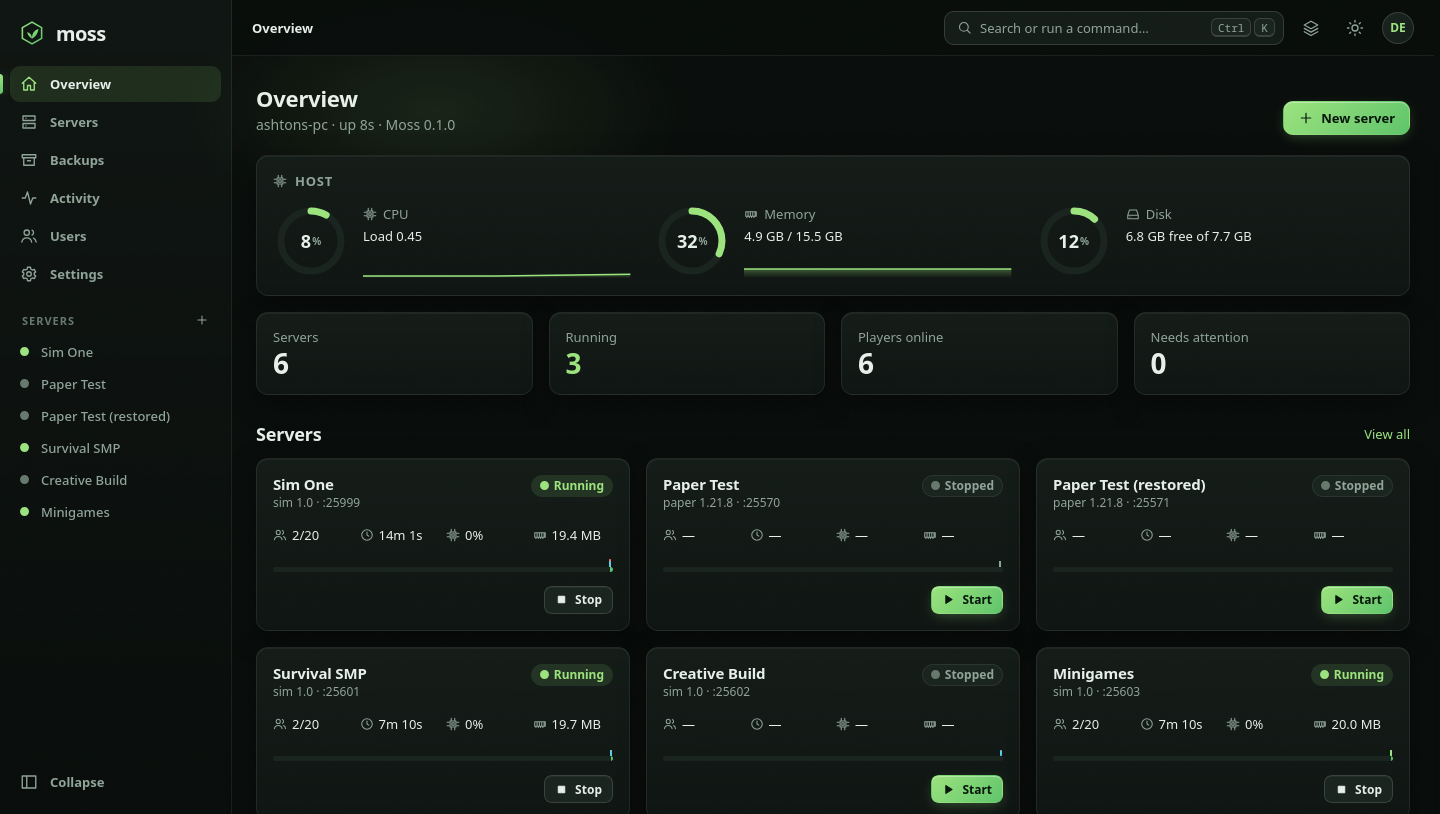
Kill the controller. Keep the game.
Most panels own your server process, so restarting the panel restarts your world. Moss launches games on their own and finds them again afterwards.
- Re-attached by PID and start time, so a reused PID can never be mistaken for your server.
- Console keeps working. Input goes through a FIFO the game itself holds open.
- Crashes are told apart from stops, with exponential backoff and a crash-loop breaker.
$ moss serve
✓ Paper 1.21 ready · 3 players online
$ kill -9 $(pidof moss)   # the controller dies
! panel offline · game still running, players still playing
$ moss serve
↻ re-attached to Paper (pid 48211), tailing console
✓ nothing was interrupted
Everything a server needs, nothing it doesn't
Built around what goes wrong at 2 a.m.: crashes, bad updates, full disks, missing backups.
Servers outlive the controller
Games run detached and are re-attached by PID and start time. Restart or upgrade Moss mid-game; nobody gets kicked.
Undo for everything it touches
Editor saves, server.properties and plugin changes snapshot the previous files first. One click puts them back.
Change plans
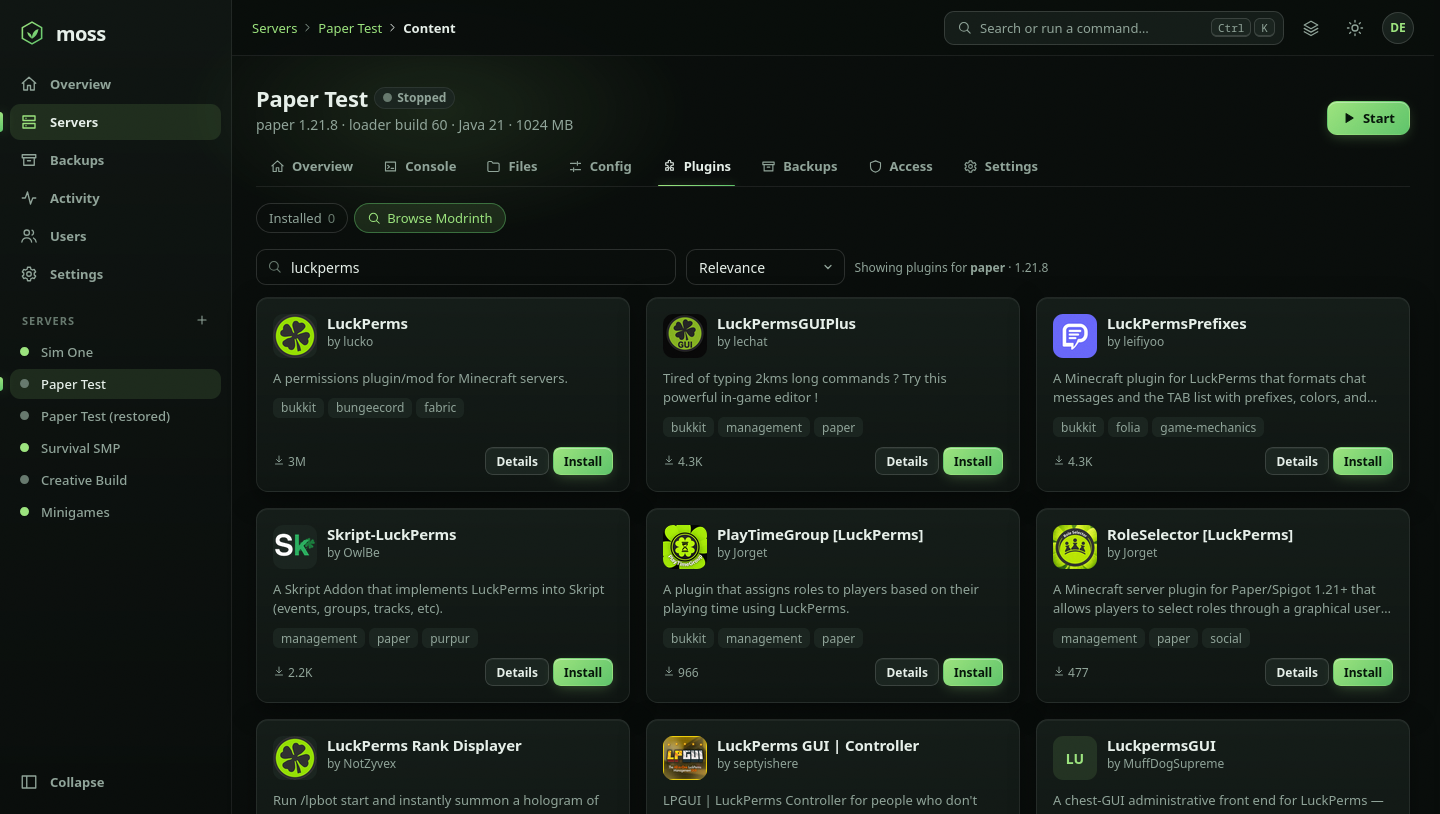
Installing a plugin shows exactly which files will be added or replaced, dependencies included, before anything downloads.
Pulse timeline
A 24-hour strip of starts, ready marks, crashes, restarts and backups. "What happened last night?" in one glance.
Evidence-backed health
No mystery score. Each finding shows its evidence and a one-click fix: install Java, back up now, accept the EULA.
Zero-setup Java
Moss downloads a checksum-verified Temurin runtime for the Java version each Minecraft release needs.
Live, consistent backups
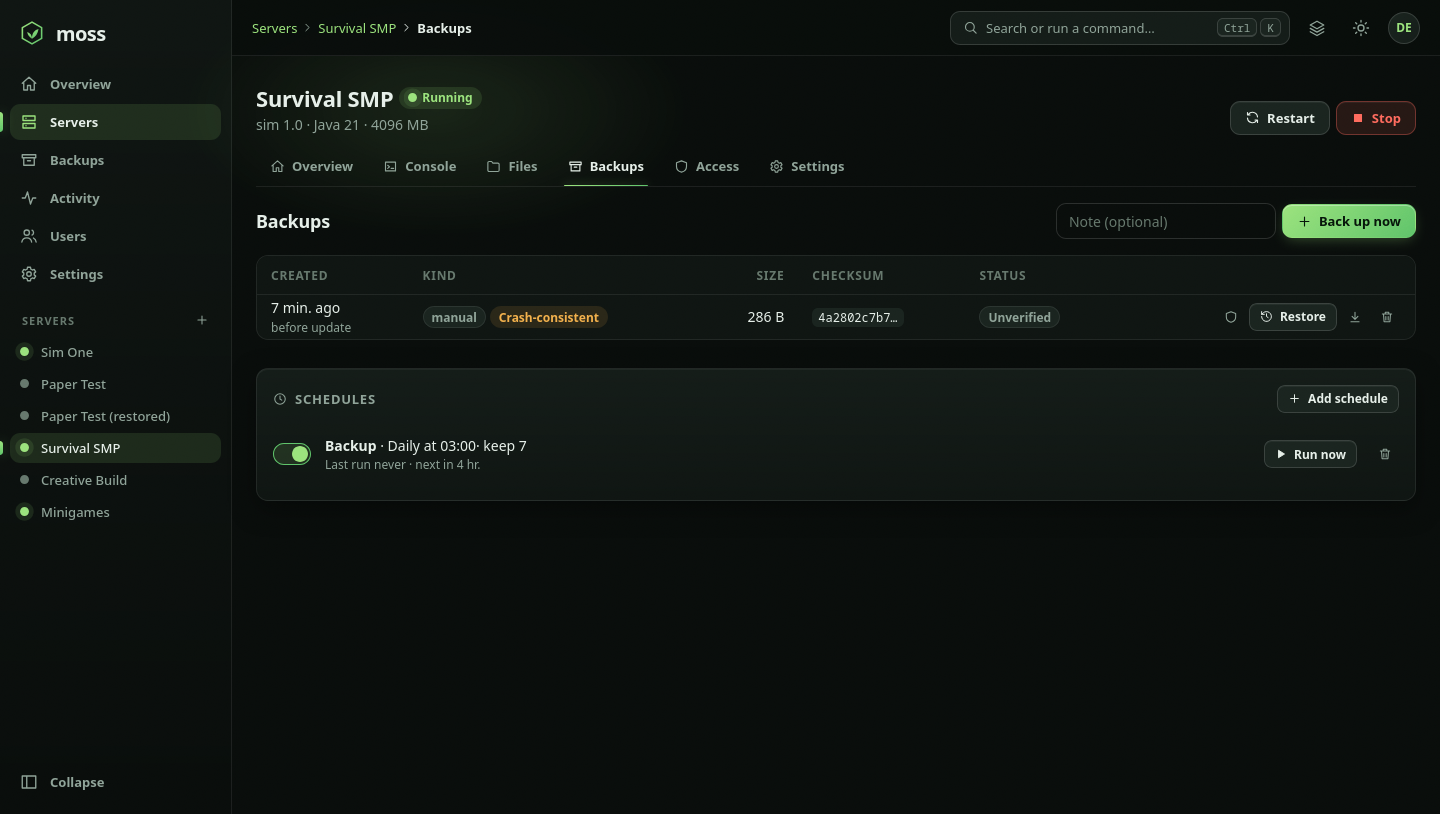
save-off, flush, archive, save-on, confirmed from the console. Checksummed tar.zst you can verify and restore as a new server.
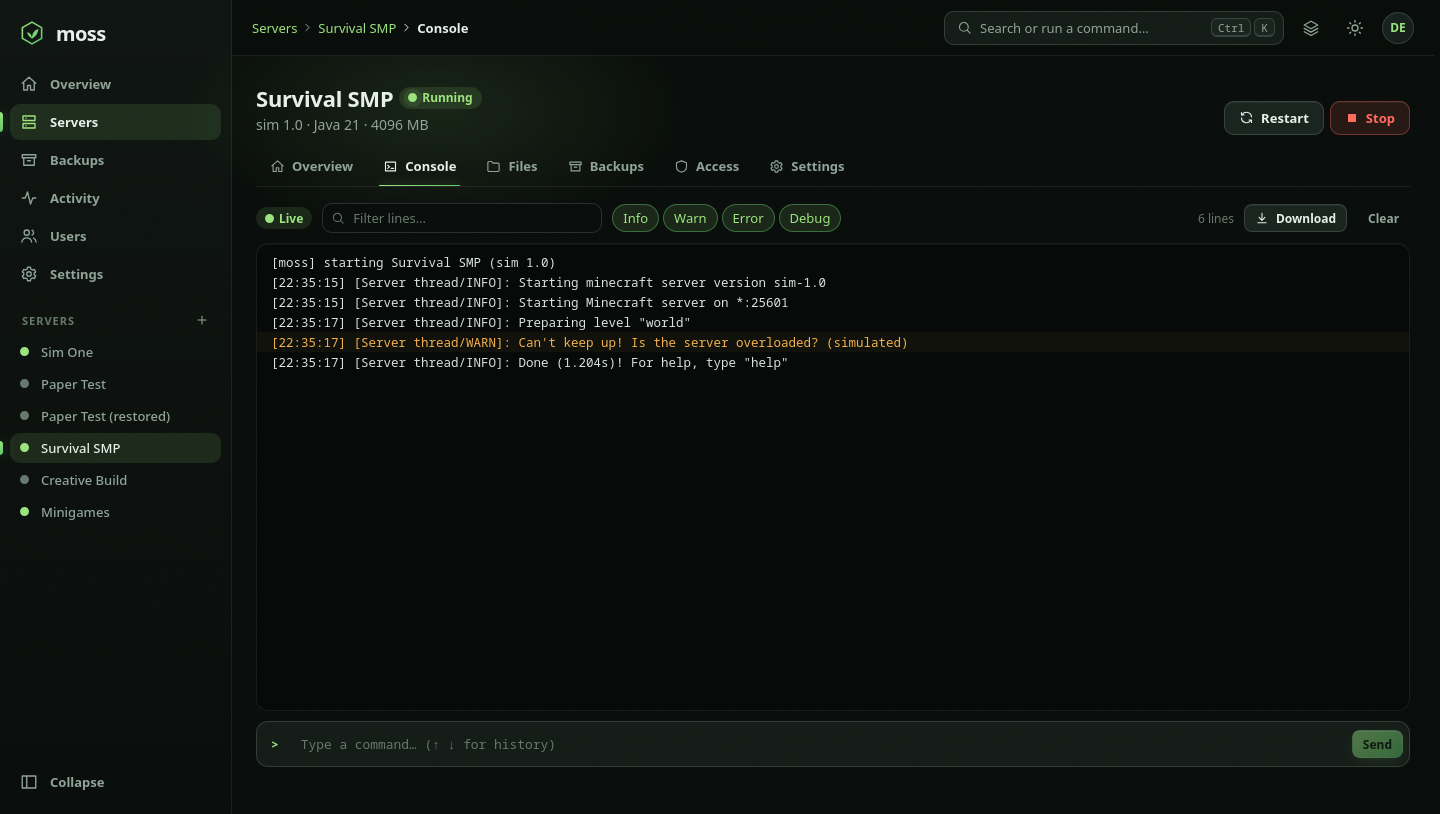
Real-time console
One log tailer per server feeds any number of viewers over WebSocket. ANSI colours render as text, never as HTML.
Roles and per-server grants
Owner, admin and user, plus manager, operator or viewer on each server. Enforced on every request.
Schedules that behave
Backups, restarts and commands on an interval or daily at a time with an explicit UTC offset. Missed runs execute once.
Hardened by default
Loopback bind, invite-only sign-in, symlink-proof file access, allow-listed downloads, strict CSP.
Keyboard first
Press Ctrl or ⌘ + K to reach every page, server and action. Dark, light and high-contrast themes.
A panel that looks the part
Dark, light and high-contrast themes, keyboard navigation, and a layout that holds up down to a phone.
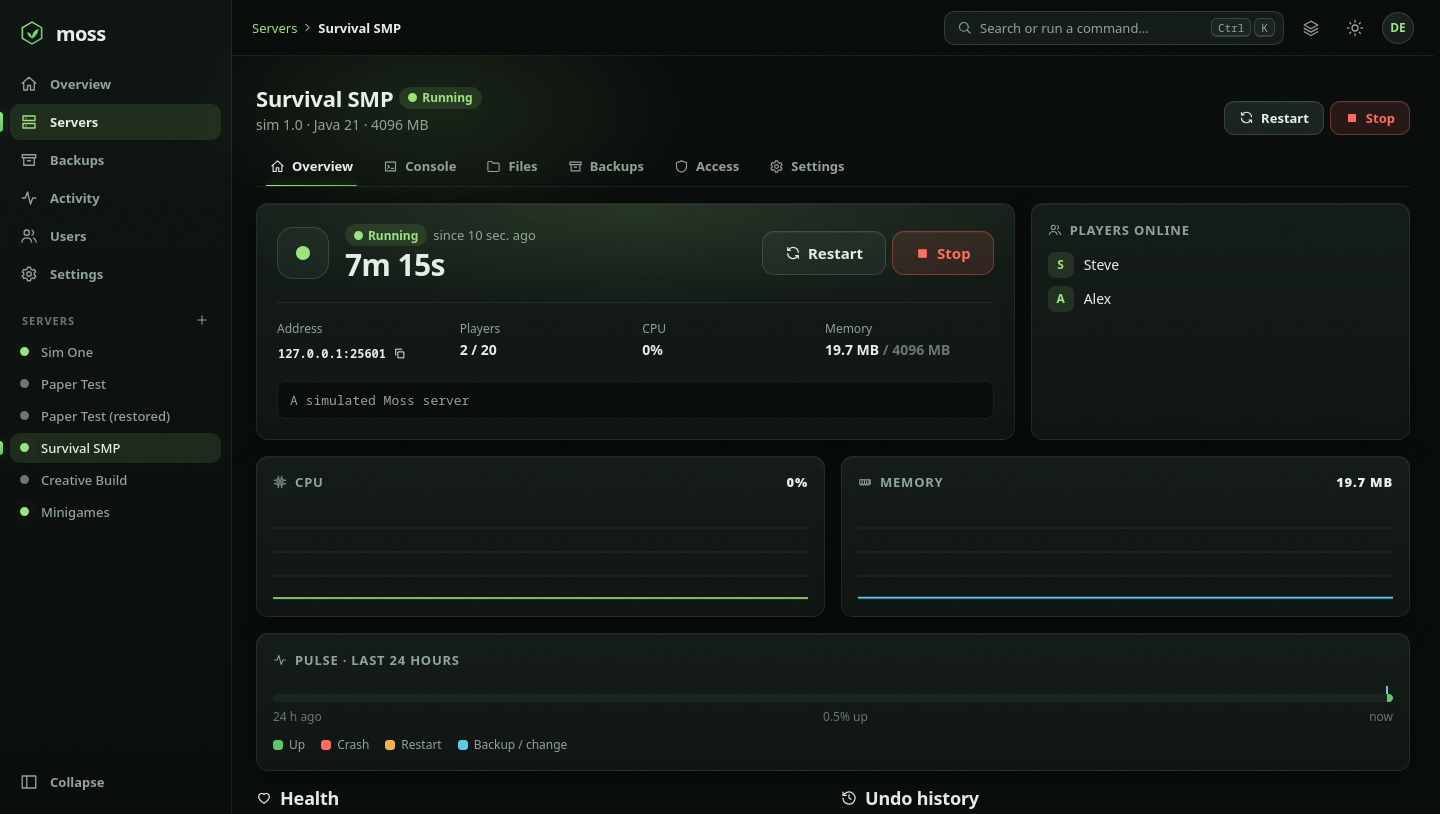
Only what works end to end
A runtime is offered as installable only when it is verified from install to console. Plugins show for Paper-family servers, mods for Fabric, datapacks for Vanilla, from Modrinth and CurseForge. Client-only mods are filtered out before you can click them.
Where it differs from a typical panel
| Moss | Typical panel | |
|---|---|---|
| Restart the controller | Servers keep running | Servers restart with it |
| Changed a config or plugin | One-click undo | Hope you kept a copy |
| Installing a plugin | Reviewed plan, compatibility-filtered | Pick a file and see |
| Backups | Flushed, checksummed, verifiable | Archive of whatever is on disk |
| Setup | One binary, SQLite | Database, queue, containers |
| Your data | On your machine only | Often a hosted backend |
Built to be exposed carefully
Sign-in is not the only line of defence. Moss binds to loopback by default, checks permissions on every REST call, WebSocket and event stream, confines file access to each server, and allow-lists every download.
Questions
Do I need an account on this website?
No. There is nothing to sign in to here. Moss runs on your own machine, and its sign-in uses a Supabase project that you create and control.
Does Moss phone home?
No telemetry. Moss contacts Mojang, PaperMC, Purpur, Fabric, Modrinth, CurseForge (if enabled) and Adoptium only to download what you ask for, and Supabase only to verify sign-in keys.
Is it free?
Yes. Moss is open source under GPL-3.0-only.
What does it run on?
Linux x86-64. Windows and macOS hosts are not supported. You manage it from any browser.
Do I need Docker?
No. Moss is a single binary with SQLite. A container backend with resource limits is on the roadmap.
Is it ready for production?
It runs real servers today, but it is early. Formats and APIs may change, and there is no container isolation yet. Keep your own backups and put a TLS reverse proxy in front of it.
Try it in a minute
Download the binary, run it in dev mode, and create your first server. No account needed.